Monday, July 20, 2015

Dangerous Beauty: Woman of power and pain!

At times many of us are products of our circumstances. Women are more likely to be one by virtue of their being constantly at the receiving end of men’s ‘mercy’! A well-made film on a medieval courtesan speaks immensely of both the power and the plight of a woman caught in a society high on moral and ethical codes, practicing none.


Director: Marshall Herskovitz
Film Clip
Veronica Franco is a courtesan in Venice. A courtesan is similar to temple and court dancers found in the ancient royal kingdoms in India. Veronica becomes a courtesan not by choice but circumstances. The man she loves, a senator from a royal lineage, cannot marry her because of his class. By dint of her being a courtesan, she is loved and hated at the same time. But what no one can deny is the fact that Veronica is much more honest, devout, passionate and innocent of heart, even as she is learned and intelligent, than all those who claim to be the conscious keepers of society.
In the end, though, the cruel joke of Church Inquisition takes almost better of her, but for the one man she loves standing up for her. He not only wants to save her, but save the Church and the State from punishing an innocent woman and spare all those high cultured men who were her ‘accomplices in witchcraft’ for which she was supposed to be condemned.
Catherine McCormack as Veronica richly deserves accolades for donning a character into which she effortlessly immerses herself. Each of her expressions is so delicately constructed that you cannot but feel with a woman brutalised by a cruel society.
The film also gives a glimpse of what Inquisition was all about and how dangerous and ruthless the Church-State combination at one time was!!
- Melwyn Pinto SJ

Thursday, June 18, 2015

The Story of the Weeping Camel: Life as it comes!

The Story of the Weeping Camel is a heart-warming docu-drama about a nomadic tribe in Mongolia and their association with and attachment to their domesticated animals, especially camels. Though the story narrates the plight of a new-born camel that is rejected by the mother, the free, happy un-baggaged life of the nomads comes alive in the process.


 Dirctor: Byambasuren Davaa
 Dirctor: Luigi Falorni
Film Clip
What we come to know from the film is that this tribe lives life as it comes to it. They are happy with whatever they have and earn. They are not unduly concerned about amassing possessions for posterity. They travel with their animals from place to place in search of greener pastures and find life along the way.
Not that everything is hunky dory for the wandering tribe. They have their lows as well. Animals and their protection is their biggest concern. Here in the film, the calf is rejected by the mother as it had to suffer a great deal while giving birth. The tradition has it that the mother camel needs to be cajoled and nursed with singing and music to the accompaniment of a traditional violin into accepting the young one. The family in the film brings a musician from the town and then there is this moving scene of the mother coming to terms and shedding tears. The union of the mother and the calf is the ultimate climax that moves the audience as well. 
For an outsider the life of a nomadic might look primitive and short of all the novelty and excitement of the modern buzz; but none can dispute the excitement that they find in their daily joys of life, something that the stressed world would do well to cultivate.
The film is directed by Byambasuren Davaa and Luigi Falorni.
- Melwyn Pinto SJ

Wednesday, May 27, 2015

Where do we go now?: Dousing communal fire

In most cases, the cause for communal flair is invariably a flimsy reason. However, it takes a giant effort to douse the fire of hatred. Well, it is not that impossible to build a society on communal harmony, except that someone has to do some hard work and someone will have to ‘pay’. The Lebanese film Where do we go now tries to deal with such a sensitive theme.


Director: Nadine Labaki

Film Clip
As expected, in any situation of communal disharmony, women are the ones who have to bear the brunt. And as the director rightly assesses, it is the women who unfortunately have to make great efforts to make reason work rather than emotion. In this film, their giant effort, of course, pays in the end. 
The story is about a village in Lebanon where Muslims and Christians have for years lived in harmony. However, the good times as they say are not to last forever. Skirmishes on communal lines give rise to violence and death, resulting in women losing their husbands and sons. While the women reason out that it is only by communal harmony that they can survive, the men are as unreasonable and blind as ever, being consumed by their ego.
It takes some bold, risky and, of course, creative efforts on the part of these tired women to bring about some sense and peace in the village. The film indeed is a brilliant portrayal of a society that thrives on ego clashes and religious fanaticism. The film lays threadbare the character of a society that cares less about human lives and more about religious bigotry. 

- Melwyn Pinto SJ

Monday, April 27, 2015

Dhag: The fire all around!

Here is yet another important film in Marathi that deals with a unique subject. The film won several national awards last year, including the best actress award for Usha Jadhav. The film deals with a caste related practice. Here is a family whose family trade is cremating the dead in the village. Ironically, it is in the death of someone that the family must find its living.


Director: Shivaji Lotan Patil
Film Clip
The problem becomes acute when in a sudden turn of events, the man in the family dies of snake bite and the young son has problems continuing with this practice. Though the son wants to study and become someone in life as per his father’s wish, he realises how the eventuality has brought in several other problems to the family, including the lustful advances of men towards his mother. It is in this context that the son must make a decision of his life.
The young Hansraj Jagtap as Krishna adds life to a film which in parts turns melodramatic. The suffering that a caste related trade brings to a poor family can be seen and felt through the tender yet mature expressions of this young boy. The blaze (dhag) is not just that which emanates from the pyre, it is there even in his eyes. The film, of course, does not end pessimistically, which is its strength. There is hope even when the fire blazes all around you.
- Melwyn Pinto SJ

Friday, April 03, 2015

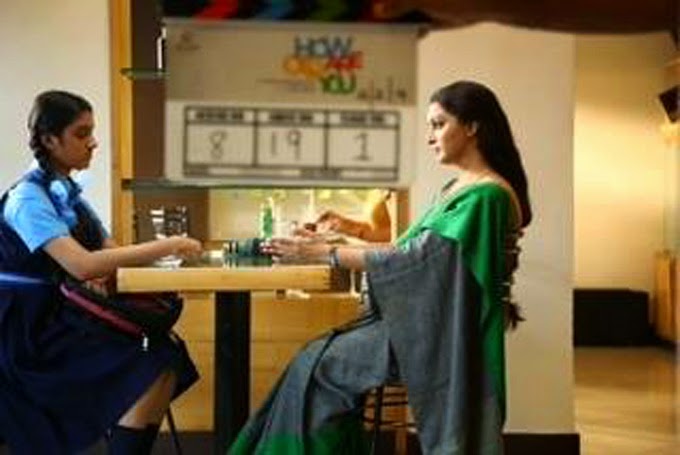
How Old Are You: Woman in the centre!

Women-centred films are not new in Malayalam. In fact, the new generation Malayalam films have strong women characters and there are several films in this genre that are centred on women. How old are you is yet another significant and praise-worthy addition to them.


Director: Rosshan Andrrews
Film Clip
It is a film about women living their dreams. The message is straight forward: women are not to be confined only to the household, cooking and taking care of children. They can also strive to achieve their dreams, only if they are determined. And, no-one but themselves can be their guiding hand in this pursuit.
Nirupama is just like any other housewife, taking care of the household having internalised that her life is only that. However, things change dramatically for her, when she comes to know that she is derided for her naivety and less than confident attitude to life. Timely comes the help from her classmate, through whose words of support she defies logic to turn out to be a successful entrepreneur, gaining respect from her husband and her little daughter as well.
The film raises several pertinent issues: Why should a woman always sacrifice her dreams for the sake of her family? Why not help her also to go beyond the narrow confines of family and kitchen? We can also have as many women entrepreneurs as men, if not more, provided men do not feel insecure and threatened by them. And finally, when a woman blooms and flourishes in and through her dreams, not just an household but a society she engages with also blossoms, for the nurturing qualities of a woman will always come alive naturally in every decision she takes, and every change she brings in. At least that is the message of the film. Full marks to the director Rosshan Andrrews and the lead character Manju Warrier.
- Melwyn Pinto SJ

Tuesday, February 24, 2015

Ida: Search for identity!

Ida is a Polish film which won Oscars in the Best Foreign Language Category at the recently held Academy Awards. And it deserves the accolades for its sensitivity in dealing with the subject. The film is the story of a young nun Anna (played by Agata Trzebuchowska) who was orphaned during the World War II. She is now determined to meet her aunt and find out about her parents, before she could take her religious vows.


 Film Clip
Director: Paweł Pawlikowski
The journey, though, takes her to hitherto uninhabited terrains and situations, which she finds both revelatory as well as momentary. Even as she discovers how her parents were killed, she is not disturbed beyond a point about the events that took place in the past and shows remarkable calm and composure. Even when she comes to know that she was born a Jew, she is not overtly amazed and thus does not indulge in exaggerated emotions.
And that perhaps is the strength of the film. Throughout, one gets to witness characters contrasting in nature, yet not resorting to undue pomposity. They go about their role play nonchalantly, giving the film its richness and artistic value.
Agatha, the young nun, is just the right character to play the role of a courageous and indifferent girl. Her performance has elevated the character, and of course the film, a notch or two higher in quality. Full marks to director Paweł Pawlikowski for his effective handling of script and screenplay.
- Melwyn Pinto SJ

Saturday, January 03, 2015

PK: In search of God!

Controversies about the film PK are yet to settle down. Meanwhile, the film has gone on to be the highest grosser ever in India’s film history with a whopping collection of over 280 crore rupess and might even cross the 300-crore mark. One wonders if all the negative publicity the film earned actually worked in its favour. Could be. However, one cannot ignore the meticulously hewn script and strong performances of the actors.


Director: Rajkumar Hirani
PK: Behind the scene
Rajkumar Hirani, the director, is a master craftsman. All his films till date have been massive hits. And it is not so much due to extensive publicity, as painstaking efforts while making the film. He is a creative genius and knows what works in the Indian ethos and what doesn’t. To that extent, he is perhaps well entrenched in India’s cultural heritage more than the infamous rightwing hooligans.
Coming to the film, PK raises several questions about institutional religions and, of course, God. Not so much the God who is the master artisan of the universe, but god, or rather many gods, that his so called ‘custodians’ have created. It seems very funny that a godman in the film asserts that he would go to any extent to ‘save his god’. Who should save whom?
The film has come at the right time with several self-styled godmen being arrested in India for their crimes and the frenzy of people’s superstitions being exposed. PK perhaps could serve in helping people come out of their illusions and delusions. Rather than seeing the film from that angle, the fanatics are yet again out to prove that they are pontificators of all religious superstitions in India.
As always, dialogues are another strength of Hirani’s films. The class performance of Amir Khan, Anushka Sharma and others has only added to the flavour. Long live Hirani’s tribe and bad luck to the rightwing fanatics!!
- Melwyn Pinto SJ