Wednesday, August 21, 2013

The Bang Bang Club: Duty vs humanity

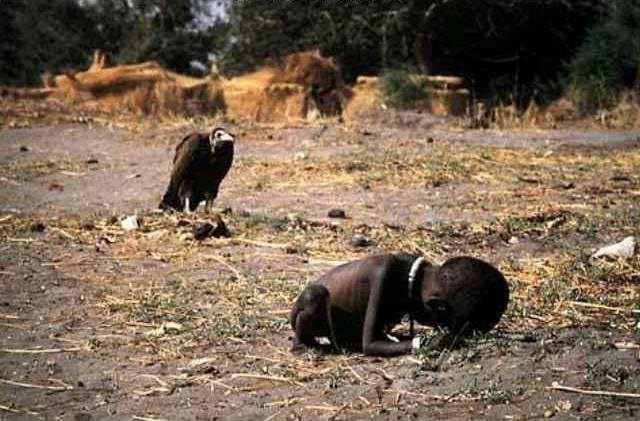
What comes first to a journalist, photographer or such other media person? Is it his/her duty as a professional or humanity? This is not an easy question to answer. The famous case is that of Kevin Carter and his Pulitzer Prize winning picture of a Sudanese girl and the vulture that was waiting to devour her. The picture, even as it won the coveted award, raised many questions as to the ethics of journalism in general and photo journalism in particular. Apparently, Kevin Carter made sure not to disturb the vulture, lest it should fly and he lose a ‘precious moment’. 


 Kevin Carter's Pulitzer Prize winning picture

Kevin Carter

Director: Steven Silver

Film Clip

Kevin Carter’s story is part of the film The Bang Bang Club (2010). The film as such is about a group of press photographers who covered the South African ethnic violence in the early 1990s. They were exceptional photographers who made news all over the world with their rare pictures taken in highly dangerous terrains of human violence. The film quite simply portrays the risk that a committed photo journalist takes just to get that ‘precious picture’. At the same time, of course, it raises questions in the minds of the audience as to why one has to push himself so hard – is it for the glory that his work would eventually bring or genuine concern for humanity? The girlfriend of one of the photographers puts it depressingly straight across to him: “May be you have to be like that to do what you do. I think you have to forget that they are real people!” Do journalists, press photographers, broadcast journalists lose their humanity in the din of getting those crucial bites and moments? The film might just throw some light on the subject. The film, though, is quite engaging and full of action throughout. 
- Melwyn Pinto SJ

Monday, August 05, 2013

Guzaarish: Seeking right to die!

If someone has a right to life under Article 21 of the Indian Constitution, does that person also have a right to die? That is the issue around which the film Guzaarish (2010) revolves. The film seems to be dealing with the subject of euthanasia. However, it is much more than that. It raises several issues such as a person’s dignity to life, which also involves dignity to die; not to mention the issue of putting an end to the prolonged suffering. 


Director: Sanjay Leela Bansali

Film Clip
The protagonist of the film Ethan Mascarenhas in his earlier days used to be a magician. However, a near fatal accident de-capacitated him completely. He became paralysed, save for his head. A dedicated nurse Sofia (Aishwarya Rai), just now makes sure that Ethan lives with dignity. However, she is not able to reduce his mental agony of being a vegetable from a state of country’s topmost magician. And this leads him to make that tough decision to appeal for euthanasia. Heated discussions within and outside court take place as regards the validity of the appeal and the uniqueness of the case. All of that indeed makes for some very exciting debating, besides stimulating the mind with nuanced insights. However, the court cannot really break from the law of the land. Can it?
The film has some very high octave performances by Hrithik Roshan, Aishwarya Rai, besides others. While the film itself is quite moving, making us see the point of the protagonist, it sure leads us to some serious reflection. Of course only if we go beyond the film’s exquisite embellishments of sets and costumes. Full marks to Sanjay Leela Bansali!
- Melwyn Pinto SJ

Wednesday, July 17, 2013

Pentagon Papers: Source that cares

'Pentagon Papers' expose in the early 70s by the New York Times was one of the sensational exposes in the world of journalism. Of course, Watergate, which came later, was even more sensational for more than one reason. However, the Pentagon Papers became sensational because the source was one of the insiders and a stakeholder so to say. Daniel Ellsberg, the whistle-blower, was a researcher with the defence department and had access to piles of papers (reports) dealing with crucial classified information that dealt with the Vietnam War and the American hand in it. Through the expose the world came to know that the US wanted the war to somehow continue and prolong for its own ulterior motifs. Several Presidents selfishly made thousands of US soldiers victims and martyrs of the brutal war. In the end, what remained was a humiliating defeat at the hand of a tiny nation. All this mayhem for no worthwhile cause!


Daniel Ellsberg, the whistleblower

Director: Rod Holcomb

Film Clip
In a landmark decision, Ellsberg was acquitted by the court which declared that the case was a ‘mistrial’. It was a vindication of the fact that Ellsberg had done what he did in all good faith, keeping the future of a democratic country in mind.
The film Pentagon Papers (2003) has documented these facts quite faithfully. Through the film one comes to what extent a powerful nation can manipulate everything and keep the entire nation in the dark. It happened during Vietnam War, it happened during Iraq war and several other wars. For the US, might seems indeed right! James Spader who plays Ellsberg, has done justice to the role of a whistleblower  A must watch film for students of journalism as well as those interested in knowing more about American hypocrisy and manipulation at the same time. 
- Melwyn Pinto SJ

Saturday, July 06, 2013

The Boy in the Striped Pyjamas: Cruelty and irony of war!

The boy in the striped pyjamas (2008) is a compelling and painful tale of the horrors of world war II. The unique feature of this film is that it tells the brutality of the war without actually showing it in as many images. The whole film is narrated through the eyes of an 8-year old Bruno (Asa Butterfield), son of a German Nazi soldier. Even before Bruno understands what the war is all about and why Jews are not ‘People’ as his father tries to tell him, he is consumed, ironically, by its cruelty.


Director: Mark Hermon

Film Clip

The film is based on a famous novel of the same name written by the Irish novelist John Boyne. The film is directed by Mark Herman.

The film raises many questions about war. In fact, the most important aspect that the film tries to send across is that war originates and is fought first in the mind. What we see outside is just the expression of the brutalities caused by the mind for no gain. Even as six million Jews were killed in the war (the film has a reminiscence of it), the Nazis tried to convince people that the Jews had to be killed as they were subhuman and a threat to the greater nationhood of Germany. Bruno, the protagonist, however, finds it extremely difficult to fathom this ‘reality’ and hence becomes an ironic victim of sorts of the same war.

The film has been narrated with a touch masterly craftsmanship with brilliant performances by the actors, especially Asa Butterfield as Bruno and Jack Scanlon who acts as the little Jew, Shmuel. The friendship that these two build up in their brief period of meeting, makes one sit back and reflect whether breaking barriers after all is such a big difficulty at all! 
- Melwyn Pinto SJ

Monday, June 17, 2013

The Song of Sparrows: Honesty pays!

Here is yet another brilliant rendition of Iranian new wave by the master Iranian director, Majid Majidi. It is a typical Iranian film, sensitive with its ordinary life portrayal of a poor family. The father Karim, played intensely by Reza Naji, struggles hard to make ends meet. In the bargain, though, he loses his job in the ostrich farm, as an ostrich escapes from his care. Further, he also fractures his leg in a freak accident. However, what keeps him going and what, perhaps, helps him face life as it is, is his never compromising honesty and his deep love for his family and children. He is unsophisticated; but Karim can strike a deep chord. He reminds us of Ricci of De Sica’s Bicycle Thief. However, the only difference is that while Ricci is driven to sin in the face of helplessness, Karim fights helplessness with determination and hope.


Director: Majid Majidi

Film Clip

Majidi, as usual, gives masterly touch to this film as well. The journey motif that is a characteristic feature of most of Iranian films is predominant in this film too, where we see Karim journeying physically and metaphorically into places and circumstances which he would otherwise not have intended. Some of the shots in the film are just breathtaking. For example the splatter of fish in the tub as it is dropped by the children; or another shot of Karim carrying a door in the vastness of a field. This sensitive film will go a long way in re affirming the beauty that life is. 
- Melwyn Pinto SJ

Tuesday, May 28, 2013

Patch Adams: Healing more important than cure

This may be an old comedy, but its relevance is timeless. The message this film sends across is that love, laughter and affection can go a long distance in healing a person more than the usual doses of medicine. Well, there is a great difference between ‘cure’ and ‘healing’. A physical disease may be cured by the medicines prescribed by the physician. However, there is no guarantee that the person is healed. Healing has to do with the whole person and not just his or her physical ailment. Even a person with multiple physical ailments can be a completely healed person when he/she is completely free from within.


Director: Tom Shadyac

Film Clip
That is where love, laughter and affection come into play. Here is Hunter Adams, nicknamed Patch Adams (Robin Williams) who learns a great lesson that the only way to forget one’s problems is to get involved in the lives of others and bring them happiness and joy. Hence, he makes a life decision to become a doctor so that he can come closer to those suffering and in pain and ‘heal’ them. Of course, the traditionalists at the medical college and hospital where he is studying have a problem. However, Adams pursues his goal with a single-minded devotion to bring about and spread healing.
The film, no doubt, stirs us to think about the present-day medication system which focuses largely on the disease rather than the person. For most doctors, the patient is just another ‘case’ and no more a person. Such treatment can only make the person sicker than bring about healing. The ‘great lesson’ medical students learn in hospitals that they must be detached from their patients and treat them just as cases with diseases, is unfortunate. This way you create doctors who are robots and not human beings.
Great film! Well, Munna Bai MBBS has been inspired by this film.
- Melwyn Pinto SJ

Thursday, May 09, 2013

Bharat Stores: Swept by market economy!

The impact of globalisation and liberalisation on small scale industries and businessmen has been a known factor. Series of researches and studies have analysed these developments. However, not many films have dealt with this subject. The national-award winning Kannada film Bharat Stores seems a very realistic depiction in the recent past, dealing with this theme. 


Director P. Sheshadri

Film clip

The film is basically about a shopkeeper Govinda Shetty who is honest and dedicated to his family trade. However, with the rise of market and free trade economy post liberalisation process, he suffers a huge loss steadily, till he is completely outplayed by the growing mall culture. His inability to move with the changing trends, or refusal to compromise with the system, does him great harm, till one day he bites the dust unable to recover.

The film, with some fine performances (especially the protagonist Dattatreya) and exquisite camera work by Mahendra Simha raises several crucial questions. Is it wrong for people to frequent malls when they know that they can shop all that they need under one roof? Should malls be restricted to allow small traders to also do some business? Is it a fault of Mr Shetty that he could not upgrade himself like many others with the current trends in business? Was he so old-fashioned to not see that he could be decimated?

There are no easy answers. However, Bharat Stores, the shop, with its fading light and near empty space towards the end of the film stands as a powerful symbol of the gale of globalisation and liberalisation that is driving farmers to suicides, killing small scale trades and businesses and driving scores of families that were dependent on the street corner shops into penury.

Hats off to director P. Sheshadri.
- Melwyn Pinto SJ