Tuesday, May 29, 2012

Kahaani: A story that wasn’t

Everyone knows that terrorism is a complex and dangerous labyrinth of irrational minds. However, can it even be a power-house that involves an unholy nexus between so called well-meaning, socially respected civilised officials, bureaucrats and extremists? Scholars and experts on the subject do not deny the existence of such a possibility. A terrorist will never be able to achieve his ‘lofty’ aims unless he has a clue as to how the government machinery functions from inside.

The theme of the film Kahaani is just that. It brings forth a very complex issue of extremists making the best use of government research through the help of some insiders to carry out their terror acts. While watching the film one cannot but wonder if such could be the case in reality, the film, however, looks a convincing fiction.  The nexus between the underworld and politicians and government officials has long been established. 


Film Director: Sujay Ghosh


Film Clip


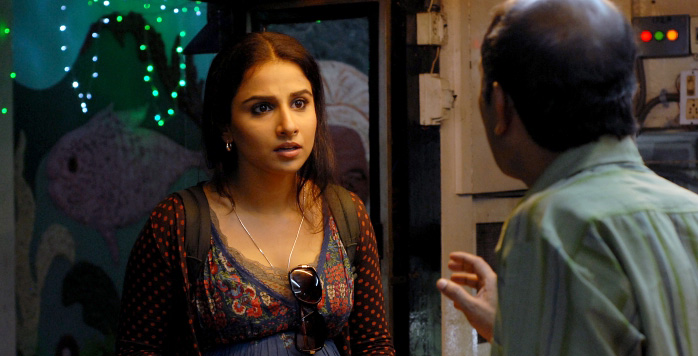
Apart from this intriguing issue, what makes the film special is the character Vidya Bagchi played by Vidya Balan. She seems to be in an eternal search for her lost husband. While she finds answers to the mysterious disappearance of her husband, her search for a state of reason in a world ravaged by mindless violence and useless warfare would never end.

Vidya Balan has absolutely personalised the role of a searching spouse. As Inspector Rana (Parambrata Chatterjee) puts it at the end, Vidya Bagchi never existed; she is just an illusion. Indeed Vidya epitomises the illusory character through her seamless expressions.

A good film must stimulate questions rather than giving ready-made answers. Kahaani indeed raises very many compelling questions and leaves the audience into deep thought for long.
- Melwyn Pinto SJ

Tuesday, May 15, 2012

The Chorus - education through music


There have been several films which have teacher as the protagonist. To Sir With Love and Freedom Writers come to mind immediately. But this 2004 French film The Chorus (Les Choristes) is unique, because here the teacher uses music to tame and mould a bunch of impossible boys. Thus music is the second protagonist in this film.


Director Christophe Barratier

Film Clip

Clement Mathieu played by Gerard  Jugnot, though looks like a dumb guy, is an exceptional teacher who can very well read the minds of the boys. In fact, he is a genius, which the boys realise but slowly. While their Principal, a Hitler style terror, thinks punishment is the best way to train boys, Mr Mathieu has other ideas. He uses music to engage boys and to discipline them.

Among other things, the music score composed by Bruno Coulais is just superb – it’s sensitive and it’s heart-warming. Further, young Jean-Baptiste Maunier who plays Pierre Morhange is indeed impressive as the gifted singer.

The film, no doubt, raises many a question about the present day education system worldwide, which is bereft of attention to students’ overall well being and focuses largely on dry academics and discipline. While students need to learn discipline in life, there is more than one way to master and impart it, which not many educationists understand. Helping students engage in activities their heart is in and allowing them to discipline themselves would be a far easier way to educate students than the hard way of screams, yells and brickbats. The Chorus seems to suggest just that.

Director Christophe Barratier has been more than successful in brining the best out of the crew to make a well crafted art work that stands out for several reasons.
- Melwyn Pinto SJ

Sunday, April 29, 2012

Deool - depicting struggle between religion and life


In the last couple of years or so, Marathi cinema has been very vibrant what with several brilliant films hitting the screens. Mind you, Marathi language has a rich tradition of literature and theatre, but not cinema. Owing to the Bollywood epicentre, Mumbai, Marathi cinema has had no big audience. However, this weakness seems to have worked as a strength for Marathi cinema as there is a parallel movement of sorts emerging in Marathi. The trend began with Shwaas which was India's entry for the Academy Awards in the Best Foreign Film category in 2004.

Thereafter, Marathi world of cinema has come up with very impressive films. If the flow continues, it has all qualities of growing into a school by itself, like the Bengali movement in the 50s and 60s.


Director Umesh Kulkarni

film clip

Take for example the film Deool - the film that won the national award this year as the best film. Directed by Umesh Vinayak Kulkarni, this is an awesome tale of the extent of superstition that exists in the rural underbelly and how powers that be can use it to their advantage.

The central issue in the film is a mysterious vision that the protagonist Keshya (Girish Kulkarni) sees of a certain village god. The fall out of this in the lowly village is that all rise into a frenzied ecstasy to build a temple for the new found god. The coming of the temple, though, brings with it evils of its own nature. In the name of the god, the village prospers and politics grows. Even when the god is stolen, the powers that be deem it as their mighty responsibility to install a new god, lest the village be ‘cursed’.

Brilliantly narrated, the film works both as an irony and satire on the village ethos which struggles making a compromise between religiosity and economics. The camera work is exceptionally precise capturing the complexities of the Indian rural. Nana Patekar’s role as Bhau Galande, and the all natural Sonali Kulkarni as his wife add to the success of the film. 

- Melwyn Pinto SJ

Tuesday, April 24, 2012

Captain Abu Raed - seeking goodness in all


Jordan, as we know, is a small Muslim country in the Middle East. Rarely have we heard of Jordanian films. Even as the neighbouring Iran produces hundreds of films, Jordan has produced hardly any in the last few decades. In fact, it has produced just one full length feature film in the last 50 years. There may be many reasons for such a development. But, one of the major reasons is the lack of support for the film industry.

Be that as it may, the one film that has come in the last five decades stirs you to the core. It is not flamboyant, it is not glamorous. It is simple, straight forward and has a deep message. And the message is that there is goodness in everyone. 


Director Amin Matalqua


Film clip

The film Captain Abu Raed is a film about a ‘single’ man Abu Raed who works as a class four worker in the Airport. Accidentally, he gets the title ‘captain’ and becomes very popular among children for his fantasy stories. However, he changes the life of several of those children by seeing the goodness in them. His philosophy of life seems to be do as much as you can to make this world a better place.

The film touches you for more than one reason. For one, it calls you to goodness, without counting the cost. Second, it invites you to see goodness around.

The film works to leave a mark on the viewers, largely due to the powerful expressions and portrayal of an ordinary man in the lead actor Nadim Sawalha. The film is directed by Amin Matalqua.

- Melwyn Pinto SJ


Wednesday, April 11, 2012

A Separation: visuals speak more than words!

There are few movies which remain etched in the collective conscience of its audience long after they have been watched. These movies provoke thought, elicit questions and provide no easy answers. A Separation, the Iranian film which won the Academy Award for the Best Foreign Language Film at the 2012 Oscars, is one such movie.

A Separation is a courageous attempt, given the circumstances of cultural and artistic repression that exist in Iran. It is a movie about a crumbling marriage between Simin (Leila Hatami) and Nader (Peyman Moaadi). Simin wants to leave the country in order to create a better life for their daughter Termeh (Sarina Farhadi), but Nader is committed to staying back in Tehran to look after his ailing father who is suffering from Alzheimer’s. In the opening scene, the couple looks directly into the camera and pleads their case to a judge, an imaginary substitute for the audience. It is this incident that precedes the dissolution of their marriage and triggers off a series of events. 


Director Asghar Farhadi

Film trailer

Nader hires a maid named Razieh (Sareh Bayat), a deeply pious woman, to look after his father. Razieh has a young daughter and is carrying another child along the way. She works to ease the financial burden of her debt-ridden husband. However, after a fateful incident, she loses her child. Subsequently, the characters in the movie grapple with law, religion and human sentiment to find out who should be held responsible for the loss of the child. 

When A Separation is placed in the context of the Iranian New Wave, one can see a metamorphosis of this cinematic movement which began in 1969. Gone is the world of Majid Majidi, Kiarostami or Jafar Panhai, where we see reality from the redeeming and innocent eyes of children.

The director Asghar Farhadi’s camera work is to be admired and studied. The mis-en-scence is crafted to externally depict the inner conflicts of the characters. The editing of the film, with ample cut aways and jump cuts is perfect and seamless. The shots also depict the class conflict that exists in Tehran, represented by the differences in the colourful and upper-middle class apartment of Nader to the run-down and poverty-ridden residence of Razieh. 

- Parinitha Shinde

Friday, April 06, 2012

The Birds – a caging experience

Alfred Hitchcock’s name is almost synonymous with suspense and audiences are sure to experience the thrill of a lifetime watching his 1963 masterpiece The Birds. The film follows a wealthy socialite from San Francisco as she meets an interesting man who piques her curiosity. She buys a pair of lovebirds for his sister and, when trying to deliver them to him, finds that he has gone to visit his hometown for the weekend. Being headstrong and used to getting her way, she traces him to his hometown. Over the weekend, strange events involving birds begin to take place.

The mastery of Hitchcock lies in that the narrative begins unassumingly following a seemingly normal pattern of events involving romance and not much more. However, in this slow and steady approach leading up to the attack of the birds, Hitchcock reveals the story layer by layer, demonstrating how build-up is the key to suspense.


 Alfred Hitchcock


Film Clip

When the birds begin attacking, it starts with isolated events that increase in frequency and violence. Expressions are captured and rendered so effectively so as to convey the sense of terror faced by the characters. The main characters are trapped in the house being attacked by birds and it seems a reversal of roles – humans are now caged inside the house.

One of the best shot scenes is when the female lead actor is attacked in the room towards the end of the film. Here, elements of mis-en-scene and montage are combined in a manner reminiscent of the famous shower scene from Hitchcock’s Psycho. The shot has multiple takes, each focusing on different angles of the attack, which combine to effectively convey the terror and brutality of the attack.

The film does not close with the words The End, as most of his films, but rather closes with only the people driving away in the car surrounded by the birds watching them. This speaks to the audience, telling them that the horror does not end. It continues.

The film has been interpreted differently by different people. But, one aspect that comes so obvious to us through the film is that you cannot endlessly cage nature, lest you should be caged by it.

- Elliot B Clarence