Monday, February 17, 2014

Gravity: A journey into spaces!

Alfonso Cuaron is a Mexican director whose unique perspective and confident camera work make him a force to be reckoned with in Hollywood. In a movie industry dominated by blockbusters that boast high-grossing actors, 3D and special effects, what makes Cuaron’s work stand out is his definitive treatment of these elements.

In his multiple Oscar nominated film Gravity, Cuaron constructs a story that is set entirely in space. The film follows the harrowing journey of two astronauts – Dr Ryan Stone (Sandra Bullock) and Matt Kowalski (George Clooney) – as their routine space shuttle mission goes horribly awry. After the debris from an exploded Russian satellite begins to hurl around the orbit of the Earth, the two astronauts witness the destruction of their shuttle. They drift through the vast recesses of outer space, some 370 miles above Earth, struggling to survive the unforgiving conditions while finding a way home.


Director: Alfonso Cuaron

Film Clip
Alfonso Cuaron, together with masterful cinematographer Emmanuel Lubezki, juxtaposes familiar realms with the unfamiliar. The astronauts straddle the terrain between two worlds, that of Earth - magnificent, majestic, and comforting – and that of space – infinite, mysterious, and frightening. The camera flows seamlessly, shifting from third person to first person points of view. There is ample use of long shots which are used effectively to dissuade the audience from looking away even for a second. The visuals have a mesmerizing hold on the viewer.

Bullock is remarkable as the rookie astronaut who must battle her inner demons as much as external obstacles. Clooney, as the veteran mission commander with a penchant for spinning yarns, is endearing. The journey of these characters is as much spiritual as it is physical.

The film explores the binaries of science and faith, heaven and earth and life and death. These dualities are not in conflict with each other, rather they are coexistent. While space exploration is seen as the pinnacle of human advancement, there is a recurrent motif of God as an omnipresent force.

The director’s creative audacity, the unparalleled cinematography and the portrayal of the indomitable human spirit are reasons that make Gravity a visual odyssey which must not be missed.
- Parinitha Shinde

Tuesday, February 11, 2014

A Dark Truth: Fighting tyranny of privatisation!

The film A Dark Truth (2012) is a very relevant film for our times. It deals with an issue that has lasting impact on the future of democracies: namely the unapologetic embrace of market economy and privatisation. The trend today is for governments to slowly withdraw from their key responsibilities and hand them over to the private sector. What this essentially means is allowing markets to determine people’s lives in all possible ways. While water is being privatised in several countries, days are not far away when even the air we breathe may be up for sale. 


Director: Damian Lee

Film Clip

In the film, a private company has made water as the most precious commodity, of course, in connivance with governments. In Ecuador, the army is killing thousands of people just to hush up the sins of this company. However, the film shows that there are still some sane voices out there who do not want to give up and they fight till the end to bring the dark truth out. Of course, Francisco Francis, who leads the fight back regrets that he responded violence with violence. He comes to know through his own experience that Gandhi’s ways are more practical and effective than those of Mao.
Forest Whitaker as Francisco Francis and Andy Garcia as Jack Begosian make a deep impression. While the film may have exaggerated the reality a bit, the point is well made. The world is not in itself unequal, but greed makes it so. However, the optimistic note that comes up at the end of the film is what is declared by one of the characters in the film: everything has a price, but everything need not be for sale.
- Melwyn Pinto SJ

Monday, January 27, 2014

Lucia: The world of actual dreams!!

Lucia is one-of-a-kind film in Kannada. Among the hundreds of films that were made last year, Lucia stands out due to its rare storyline and narration; not to forget the fine performance of its protagonist Satish Neenasam.


Director: Pawan Kumar

Film Clip
Lucia is basically a tablet that puts you into deep sleep allowing you to dream your unfulfilled desires. The protagonist accidentally comes across such a tablet and is at once introduced into a fantasy world. In real life he desires to become a big film star, with all the added flavours being attached to the stardom. However, he can only fantasize about it and can never imagine even getting anywhere nearer to his desires. But, Lucia, the tablet, gives him that rare occasion to actually experience a fantasy world of his innermost desires.
The film appeals in that, it makes you realise that at times there is a very thin line dividing fantasy from actuality. When you sleep, you are in another world and that world is real for you, though briefly, even if it is a dream world. Freud would have written a book explaining methods to interpret dreams; but there is no denying of the fact that at times dreams can tell us much about ourselves than what we really know.
In the film Lucia, though, the director seems to convey the message that reality is not the only way to actualise your deepest desires and you need not always fulfil your dreams, rather it may be better at times to dream off your ‘realities’.
The film, even as it entertains, makes one reflect on several issues. Among others, it makes you realise that after all dreamy world is not that bad! Full marks to the creative genius of the writer-director Pawan Kumar and the inimitable protagonist Satish Neenasam. The music and songs too add to the creative narration.
- Melwyn Pinto SJ

Tuesday, December 10, 2013

Fahrenheit 451: Fear of books!

Consider a situation where books are banned or it is illegal to possess books. What would be the condition of such a society? That is exactly what director Francois Truffaut tries to show in his 1966 film Fahrenheit 451. The subject of the film might look a little exaggerated. However, it should be taken as a satire on states and societies that in different ways and means have repeatedly attempted, and at times succeeded, in subduing and silencing the voice of people.  


Director: Francois Truffaut
Film Clip

The film is loosely based on the 1953 novel of the same name by Ray Bradbury. The title apparently means the auto-ignition point temperature of paper. He wrote the novel keeping in mind the draconian censorship laws of McCarthy in the United States that attempted to silence people. In the film, a law enforcing agency goes about unearthing hideouts where books are hidden and setting them on fire. Possessing books in houses is against the law and as such can attract the ire of the state. Hence, anyone who knows of people in possession of books is supposed to report the matter to the authorities so that the agency can come and ‘deal’ with people who go against the law.
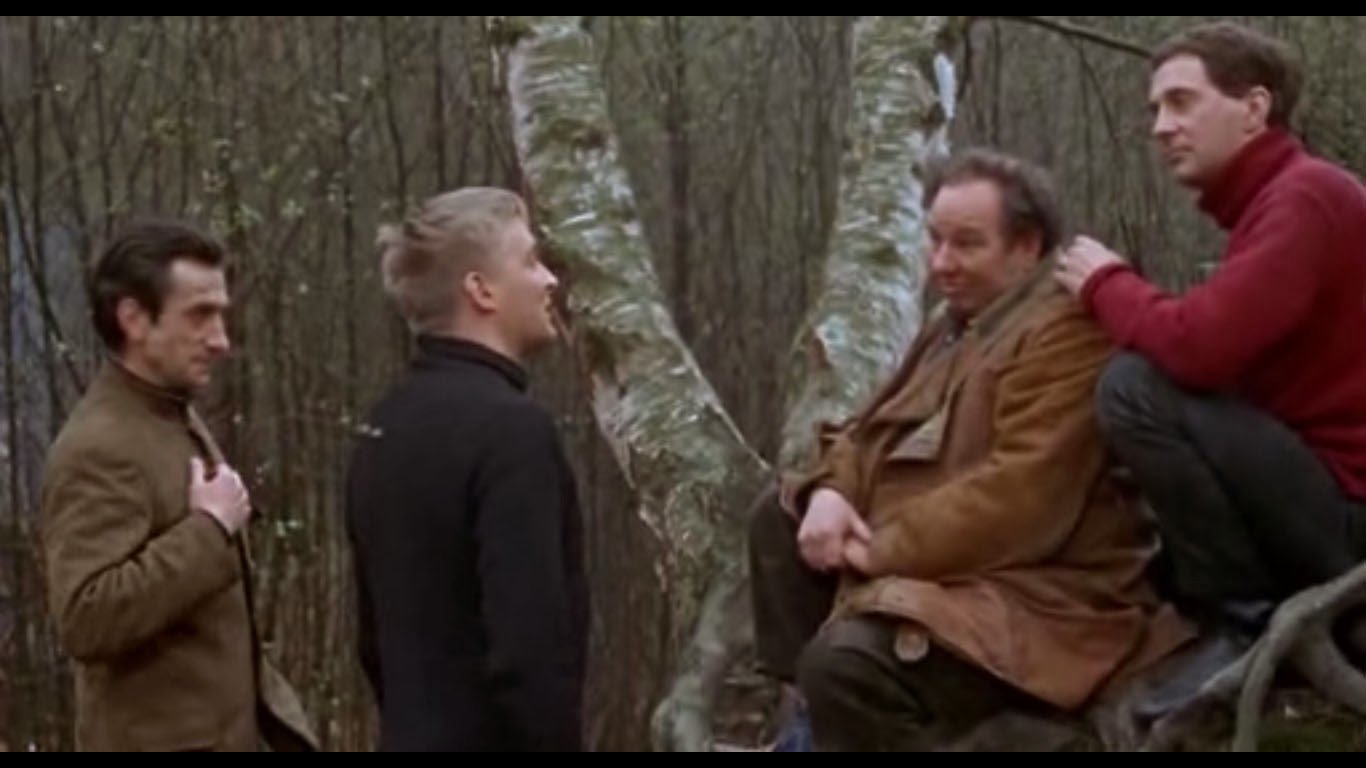
However, there is this leader of the agency by name Montag, who somehow becomes aware of the danger and implication of his action. He realises the worth of books and somehow cannot carry on destroying them. But the law catches up with him and he has nowhere to go, except to a community of book people. Book people are none other than those who preserve a book each in the most unlikely of places – their memory; and they are able to pass them on to their posterity. Such an exercise goes on to show that the state cannot really destroy books from people’s memory.
The film is indeed a masterpiece in terms of its message and delivery. Nowhere does Truffaut attempt to be preachy. The visuals speak for themselves.  
- Melwyn Pinto SJ

Thursday, November 21, 2013

Wadjda: The little rebel!

Wadjda is the first film from Saudi Arabia to be nominated for Oscars award this year. It is the official entry in the Best Foreign Film Category. The film should be called a bold attempt given the Saudi Arabian conservative circumstances.


Director: Hafeesa al-Mansour
Film Clip
The film is about Wadjda, an 11-year old girl, whose life desire is to buy a cycle for herself. It is near impossible for a girl to ride cycles in Saudi Arabia, given the religious patriarchy. But Wadjda is little bit of a rebel and wants to get it at any cost. In depicting Wadjda’s pursuit to buy a cycle, the director brilliantly presents before us different facets of a Saudi woman. Wadjda’s mother has her own daily anxieties to deal with. Her husband is out to marry another woman, and sadly, she has no control over it. Then there is the over-disciplinary and ultra conservative school headmistress who seems to have internalised the Islamic conservatism to perfection. While the director Haifaa al-Mansour suggests that it is only women who can liberate women, she also seems to send across a message that women can at times be the biggest hurdles on the way of their own liberation.
The story of the film is seen through the eyes of the protagonist Wadjda, played sensitively by the highly talented Waad Mohammed. The typical Middle-Eastern music adds colour to the narration. What makes this film important is the context in which it is narrated. Women have been fighting hard in Saudi Arabia to drive cars on the roads. The Muslim clergy is yet to be reconciled with such a demand. But, women are violating all ‘norms’ and are driving their private vehicles. This ‘revolt’ is symbolic of the greater freedom that Saudi women are demanding. Wadjda , incidentally, makes a similar, yet bold, statement en route to women’s liberation.
- Melwyn Pinto SJ

Monday, November 04, 2013

The Past: Struggle to pass over

In his recent French film The Past (2013), Academy award winning Iranian director Asghar Faradhi, carefully constructs a world of conflicted characters and fragmented relationships. Reminiscent of the Oscar award winning A Separation, this movie delves into the lives of a soon-to-be-divorced couple and explores the ripples created by their estrangement.

In the film, a French woman, Marie (Berenice Bejo) and an Iranian man, Ahmed (Ali Mosaffa), have been separated for four years.  The impetus to finalise their divorce occurs when Marie starts a new relationship with an Arab man, Samir (Tahar Rahim). While the relationship between Marie and Ahmad shows the flickering sparks of being an old married couple who have grown apart, the relatively nascent romance between Marie and Samir is tenuous and fraught with uncertainty. 


The strained dynamic between these three individuals is compounded by the fact that Samir is married and his wife is comatose. Furthermore, Marie’s daughters from a previous marriage (preceding her marriage to Ahmed) and Samir’s son are caught in the fray, struggling to grapple with the choices of their parents.  As the characters in the film negotiate their present realities, they are paralysed by their own pasts.

Faradhi peels off the layers of every character to expose the fears and truths that lie at their core. The characters in the film are inextricably bound to each other and their seemingly simple acts prove to have catastrophic consequences.  The director skilfully offers the audience a vantage point from which to explore these individuals and their revelations.

The French-Argentine actress Berenice Bejo (who gained renown for her role in The Artist) displays her versatility as the distraught and melancholic Marie. Ali Mosaffa’s character Ahmed is eager for resolution and evokes sympathy, becoming the perfect foil to Bejo. Elyes Aguis, who plays Samir’s young son Faoud, also delivers a heart-wrenching and noteworthy performance.

Director: Asghar Farhadi

Farhadi is a masterful storyteller with a flair for showcasing the nuances of human sentiments. What differentiates Faradhi’s film from the works of his directorial predecessors of the Iranian New Wave like Majidi or Kirostami, is that he extracts his protagonist (Ahmed) from the Iranian homeland. The movie unfolds in a quaintly French setting but maintains Iran as a motif. Farhadi creates a world where he explores the ideas of love, loss, remorse, tragedy and hope. His camera work, like that of Jon-Luc Godard, is unobtrusive. His portrayal of characters, like the films of Jon Renoir, is deeply humanist.

Subtle symbolism punctuates the movie. An ongoing renovation takes place in Marie’s home throughout the film, symbolic of the repairs that are due in her own personal life. In another scene, glass chandeliers jolt precariously in the back seat as Marie and Samir drive their car, representing the fragility of their relationship. Lastly, as Samir visits his wife in the hospital, her life hangs in the balance, as does the future of all the relationships between the various characters in the film.

Film clip
The Past fortifies Farhadi’s position as a ground-breaking film-maker with a definitive perspective on the human condition. It is Iran’s entry to the 86th Academy Awards for Best Foreign Language Film. Whether or not it earns Farhadi his second Oscar award, it remains a testament to his directorial prowess.   
- Parinitha Shinde